
Osteopathic Assessment and Treatment · Toronto Beaches
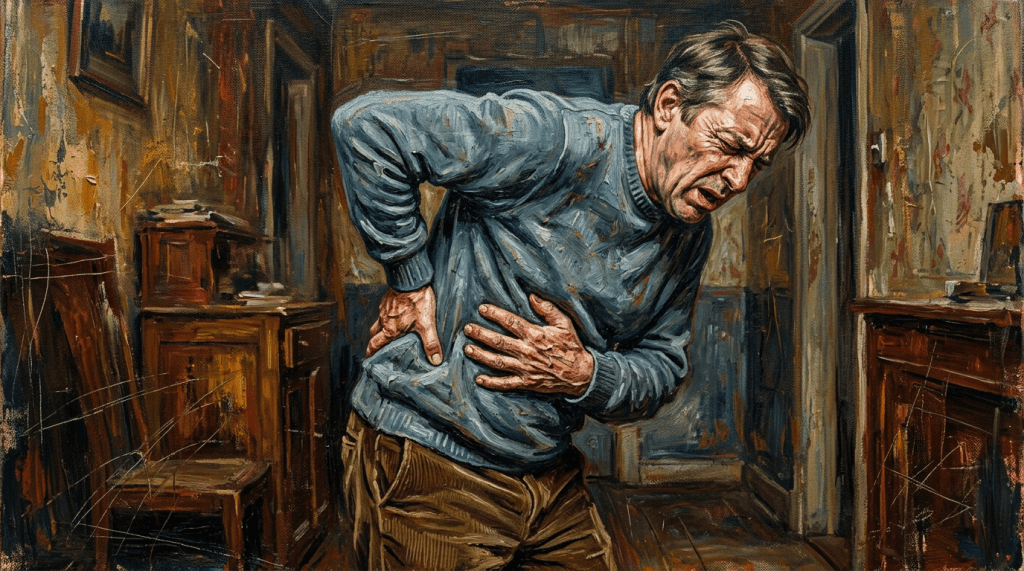
When low back pain takes over. Maybe it hurts when you move around in bed. Or it gets stiff if you’ve been sitting too long. Maybe you can’t enjoy taking a walk like you used to. When your low back is a problem, everything in life can feel like a problem.
What do we mean by low back? While the pain might be felt at the back, this area of your body includes the sides and front and everything in between. This is a load-bearing and pressurized region, transmitting forces between the lower limbs and the trunk. It’s a joined column of vertebrae and discs, wrapped in deep ligaments, muscle and fascia, connected to layers of abdominal and thoracolumbar fascia, respiratory diaphragm, psoas and quadratus lumborum muscles, containing abdominal organs, and directly associated with the pelvis below and lower ribs above. In your case, how are these structures involved in the lesion pattern that’s ultimately causing you pain and discomfort?
Osteopathy and your low back pain
Generally, assessment is about seeing how you are and aren’t moving. Watching you walk and move into the office begins to offer clues about the lesion pattern. Before you get on the table there is often a standing static view. The operator looks at how you hold yourself — where your weight settles, which way your pelvis turns, etc. Even the way your clothes hang and crease can provide good information. This is a static global assessment: you’re not moving, therefore the next and more important step is for you to move.
Here the operator is looking for normal and abnormal movements, because ultimately it’s those abnormalities that lead to or cause the pain and problems in your body, in this case low back. This is mostly a patient active assessment — you move yourself while the operator observes visually.
In acute cases the pain and immobility is often very specific to a focal joint positioning. The patient might not even be able to lay down, only sit or even just stand. That’s fine, we’ll work and find our way in however we can. That’s the beauty of Osteopathy. If it means a standing treatment, or a seated treatment, that’s what we’ll do. We’ll progress as and how your body needs it.
At this point we’re into a passive assessment and treatment, where you relax and let the operator move you around. Osteopathically, the operator is working through the structures one at a time. Globally we check if the pelvis prefers rotating one way or the other, it shows if the whole low back region is twisted from pelvis to mid back. We check your back line to see whether it’s short or long. We check if there’s asymmetry or abnormality simply by lifting your legs from your heels and swaying one side to the other. As the operator clears big lines of restriction, he also works more locally, assessing the innominates, the sacroiliac region, the lumbar curve as a whole, the abdominal wall and diaphragm in their tone, the lower ribs in how they move with each breath. Any of these may be participating in the lesion pattern and require treatment.
The hips and legs get checked because they carry load into your back with every step. If your low back hurts and your knee or foot is also bothering you, the two might share a pattern. Oftentimes, clearing the low back makes a big difference at the knee. Sometimes the leg has been holding the pattern long enough that it needs its own work to help relieve the lower back. The shoulders and lats get checked from above for the same reason. Your lats attach into the thoracolumbar fascia and the iliac crest; when your shoulder is pulling on them, your low back is being pulled on too.
Revealing the primary driver. It’s hidden until everything around it has settled. That’s the primary lesion — it needs deeper treatment. This remaining work is part of an entire rhythmic, intentional spiralling in and out of the lesion pattern at different scales.
How the work meets you
An osteopathic practitioner thinks like an engineer and works like a mechanic. Accurate assessment and treatment are based in principles, not performed as a protocol.
The operator uses simple forces like pulling, pushing, twisting, oscillating. Usually patients feel a sense of calm, even to the point of falling asleep. At times the work can be pointed and feel more intense, but the operator will never force your body to move or change in any way that it doesn’t naturally accept on its own. You’ll experience this first-hand, as your tissues respond in real time.
When the tissue stops changing, the work is done for this session. Continuing past that would be overdosing; your nervous system, fluid dynamics, and tissues themselves need to integrate the changes. Your body continues treating itself in the days after a session, moving into a cleaner configuration.
When it’s been there a long time
Chronic low back pain didn’t show up overnight. The way you sit at work, the way you sleep, the activities your body bends itself to, the old injuries it’s still working around — your back is the shape they’ve collectively asked it to take. Treatment is the process of giving it a healthier configuration to settle into over time.
Progression through treatments
Over time as your body’s configuration reorganizes, the tissues become softer and easier to move, and the treatment can reach deeper into the pattern. Your pain eases as that happens — usually correlated to how much cleaner your pattern looks. The same standing assessment the operator did on day one reads differently when you come back: you look cleaner, you stand more easily, your weight settles more evenly.
Your low back doesn’t need to be managed — it needs to be treated at the actual driver. Book a session.
Sun & Moon Integrated Wellness
579 Kingston Road, Toronto, ON M4E 1R3
(647) 375-6655 · sunmoonintegrated@gmail.com

